
• Skip to main content
  • Skip to primary sidebar

  • Who We Are
    • Purpose and History
    • Annual Reports
    • Our Guests
    • Board of Directors
    • Staff
  • Programs
    • Supportive Services
    • Main Frame Program
    • Alison’s Boutique
    • Advocacy
    • Partners
  • Get Involved
    • In Their Shoes: Annual Fundraiser
    • News and Events
    • Giving
    • Volunteer
    • #GAgives on #GivingTuesday
    • Careers
  • Blog
  • Contact Us
    • Press
  • Donate

Central Outreach & Advocacy Center

Uncategorized

August 16, 2018 By Central OAC

The Best Me I Can Be

Over the last couple of years, I’ve been doing a lot of teaching in the Main Frame.   At first this was a frightening prospect for me, and I was quite insecure about it.  As time has gone on and my confidence has grown, however, I’ve begun to enjoy it.  I love witnessing the moment when a student learns something brand new…it’s almost as if a light goes on behind their eyes.

For me, one of the most interesting things about teaching is the way students also teach me valuable lessons.  It seems like the very second I start to think that I have a subject figured out, one of our students shows me that I clearly do not.  

This truth was illustrated for me again last month.  During that class session, a Main Frame student named Ms. L kept using a phrase that stuck with me.  She would say, “I just want to be the best me I can be.” There is a lot of wisdom in that statement.  Ms. L was not concerned with what others thought of her or with what other people were doing. She focused all of her attention and energy on taking steps to better her situation by finding employment and appropriate housing.  She recently found work as a caregiver for elderly adults and is simultaneously returning to school to complete her GED.  There’s no doubt she’s blossoming into the best version of herself.

Despite Ms. L’s struggles-domestic abuse, homelessness, family illnesses, and unemployment, she has somehow managed to find a way to focus on what truly matters in the moment by asking questions like, “What can I do to improve myself right now?”  “What can I learn?” “How can I grow?”

Over the past few weeks, when I begin to compare myself to others or worry about something going poorly, I try to remember that all I can do is be the best me I can be.   Thank you for that lesson, Ms. L.

Filed Under: Uncategorized

February 14, 2018 By Central OAC

How Trauma Leads to Homelessness

by Brenna Lakeson

Many of our guests have endured different types of trauma.  From the questions we ask them during our intake process, we learn a lot about each of our guests’ stories and what brought them into their current situation.  Many have experienced or witnessed domestic violence, especially as children.  Many have experienced violence on the street – robbery, physical assault, and theft.  Others have experienced incarceration, often repeatedly.  These difficult experiences, when compounded, can influence addiction behaviors and existing mental illness.  All of these things combine create a situation that can make it nearly impossible for someone to rise above their circumstances without outside assistance.

Recently, I met with a guest named Ms. C.  Ms. C has been a regular guest over the past few months.  She struggles with mental illness, often conversing with people who aren’t there or experiencing drastic mood swings and anger.  Some days, she seems to be doing better than others, but it was clear that she would need intentional case management to overcome her situation.  On this particular day, Ms. C was interested in getting into a substance abuse treatment program.  The program that we refer to for women requires an extensive referral process and a lengthy form.  As I worked through the questions with Ms. C, I learned more about her life.

She told me about the history of mental illness and addiction in her family and the abuse she had experienced growing up.  She told me about her early use of alcohol and drugs.  She told me about the death of her husband and her son.  She told me about abuse she had experienced on the street, both physical and sexual.  After we had completed the form, it was clear to me that Ms. C had experienced a huge amount of trauma in her life but had never had the luxury of being able to process it.  She didn’t have a therapist or a doctor to help her and there was no way, in her current state, for her to gain employment to earn the money to afford the care she needs.

This catch-22 is the case for many of our guests – they need mental healthcare, addiction resources, and counseling, but do not have the stability to afford this type of care.  So, they continue to compound the trauma they experience, living in a constant state of emergency and anxiety on the street.  There are programs in place to help individuals like Ms. C, but without the awareness to ask for help from the right people, getting to these programs can also be next to impossible.

The good news is, though, that there is healing taking place for people like Ms. C.  She was able to get into the substance abuse treatment program after working with us and currently has a bed there.  In the program, she’ll have access to mental healthcare, counseling, and the structure she so badly needs.  I am grateful that I got to hear a piece of Ms. C’s story and hold space with her in her grief.  I am also grateful that she is getting the help she needs.  I have hope that she will be able to rise about her trauma and find new meaning now that she has a place to process all that she’s experienced.  In the process of filling out the forms for the treatment program, she mentioned that she loves gardening and would like to have an apartment to clean.  She also mentioned that she likes to do crafts and write poems.  I believe Ms. C will be able to do all these things and more as she begins the healing process.

Filed Under: Uncategorized

August 24, 2017 By Central OAC

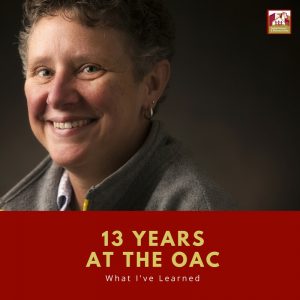
13 Years at the OAC

by Kimberly Parker

August 24, 2004

No, I didn’t get the date wrong! August 24, 2004 was my first day as a part-time employee of Central Outreach & Advocacy Center! Thirteen years ago! Who would have thought a new Columbia Theological Seminary graduate who was seeking a call in a parish would end up at Central OAC? I didn’t, and I also didn’t think I would be there very long, but after a few months, I was offered a full-time position and after a few more months, I knew that I had been called to the OAC. My parish was simply going to look a little different than the typical high, holy hour of 11 am on a Sunday morning.

During my thirteen years …  

  • I have worked under three different Executive Directors.
  • The OAC Board has had six different Chairs.
  • Two different Leadership Atlanta teams have completed projects for the OAC.
  • The Main Frame Job Readiness Program was created.
  • Three strategic plans have guided the programs and services.
  • The first Development Director was hired.
  • The first Director of Public Policy Advocacy was hired.
  • The budget has been sustainable and the budget has been in crisis.
  • Two annual fundraisers have been established: Cheers for Change and Central ArtWorks.
  • The staff has been as large as nine members and as small as three.
  • My own role has changed five different times:
    • Outreach Advocate
    • Assistant Program Manager
    • Director of Outreach Services
    • Acting Executive Director
    • Executive Director

It has been an amazing thirteen years! I have worked and continue to work with great people: staff, volunteers, interns, and Board members. I have sat with guests and heard their difficult stories. I have cried with some. I have laughed with some. I have been angry with some.  I have watched some of our guests struggle for thirteen years, something I wish were not the case. I have seen others move out of their dire situations. I have had guests come back and thank me for the work we do. I have had guests yell at me because we can’t do enough to assist them. The work has never been easy, but it has been rewarding.

I have come to understand that people experiencing homelessness are no different than you and I and with certain changes in our own circumstances, we too could be walking in their shoes. I have come to understand that the issue of homelessness is extremely complex and the solutions are not quick and easy. It takes a lot of different organizations working together, each focusing on what they do well to truly make a difference in the numbers of those experiencing homelessness. It takes resources to make it work and not all funders want to support this type of work.

I am certainly not the same individual that I was thirteen years ago, when I first walked in the doors of Central OAC. I have grown and changed as a person. As I said earlier, I never dreamed I would still be here thirteen years later. There were certainly times when I thought I couldn’t do this work one more day and there are still days like that. However, throughout these thirteen years, people have been there to support and encourage me. Without each person (and there are too many to individually thank), I would not still be here. I often say that I hope when it is time for me to leave Central OAC that I will clearly know that. For now, however, I am still serving and I am grateful for the dedicated staff, volunteers and board members whom I work with each day. It truly is a privilege to serve in this place as we all work together to open doors to overcome and prevent homelessness!

Kimberly isn’t the only one celebrating an anniversary: Central OAC is celebrating 20 years of service in downtown Atlanta! In honor of both Kimberly’s time at the OAC and Central OAC turning 20, please consider giving to support our continuing work.  Visit our donations page for more.

Filed Under: Uncategorized Tagged With: anniversary, Atlanta, homelessness, nonprofit, social good

July 20, 2017 By Central OAC

Hearing from the Source

by April Campbell

A couple of months ago, Ahren, our Main Frame Coordinator, came to the team with the idea of putting together a focus group with the goal of discussing the issues people experiencing homelessness face.  The focus group would also serve to improve how we, both as an agency and individually, could help advocate for everyone who comes through our doors. Everyone on the team thought it was a wonderful idea to provide a space for us to speak to our guests and gain firsthand knowledge of the problems they have experienced. The group was planned for December 13th, and I had the pleasure of being asked to co-facilitate the group with Ahren. I don’t think either one of us knew that by facilitating this focus group we would be introduced to so many personal tragedies, triumphs, and such a sense of community between the people in the room.

We began the group by having each person introduce themselves, if they felt comfortable, by saying just their first name. The group was quiet at first – no one said much more than what they were asked to share. Ahren and I then introduced ourselves and explained to the group how important advocacy is to the values and morals of this agency and how their stories can help us to fight the social injustices they face. We then opened the floor to anyone who wanted to share. Hands slowly began to rise, and the more people talked, the more energy was added to the room. It was amazing to watch! People were able to share their hardships with others who understood what they are going through.  People were able to share different resources they have found over the years, and in turn, helped others in the group.  People were also able to laugh together and forget, if just for a moment, what faced them when they left our doors. By the end of the focus group, our guests had come up with nineteen challenges that people experiencing homelessness face. Some of the challenges they mentioned were: affordable housing, stress and tiredness, evictions, job availability, addiction, medical care, mental health, and safe & clean shelters. One particular item that was on their list was lack of storage. When this was said, everyone in the room nodded or voiced their agreement. When the particular guest who brought it up was asked to explain what he meant, he stated, “I stay at a shelter at night and have to take all my stuff with me in the morning. I’m not able to leave my bags there. Do you really think people want me in a store or at a job interview with all my stuff? It just makes it known that I don’t have anywhere to go.” This was so eye opening to me. Everyday guests come through our doors to receive services, many times with bags upon bags in their hands. I never thought about where they would place their items if they needed to complete a task that did not allow for them to bring their belongings.

I write about this experience to say that everyone has a story.  I write about this experience to remind myself that every person who walks through our doors deal with daily challenges that I cannot even fathom. I write about this experience to say how important is it to understand what we are advocating for – to hear it from the people experiencing it and not just assuming we know their needs.  It’s because of stories like the ones we heard in our focus group that the OAC continues to advocate until all of our guests  have a place to call home at the end of the day.

Filed Under: Uncategorized

  • « Go to Previous Page
  • Page 1
  • Interim pages omitted …
  • Page 7
  • Page 8
  • Page 9
  • Page 10
  • Page 11
  • Interim pages omitted …
  • Page 13
  • Go to Next Page »

Primary Sidebar

Follow Us

  • Email
  • Facebook
  • Instagram
  • LinkedIn
  • Twitter
  • YouTube

Central Outreach and Advocacy Center, 201 Washington Street, SW Atlanta, GA 30303, (404) 659-7119