• Skip to main content
  • Skip to primary sidebar

  • Who We Are
    • Purpose and History
    • Annual Reports
    • Our Guests
    • Board of Directors
    • Staff
  • Programs
    • Supportive Services
    • Main Frame Program
    • Alison’s Boutique
    • Advocacy
    • Partners
  • Get Involved
    • In Their Shoes: Annual Fundraiser
    • News and Events
    • Giving
    • Volunteer
    • #GAgives on #GivingTuesday
    • Careers
  • Blog
  • Contact Us
    • Press
  • Donate

Central Outreach & Advocacy Center

Main Frame

May 15, 2019 By Central OAC

Our Guests Are Our Teachers

We often get the opportunity to tell our guests’ stories to educate others.  We believe that our guests are the experts on their own experiences and, therefore, are the best teachers about homelessness.  It’s a gift to witness the ways our guests are able to teach others.  Our Main Frame Coordinator, Ahren, recently witness this is a powerful way.

During the March and April Main Frame class sessions we were lucky enough to have some honors students from Georgia State University working with our job readiness students.  Many of these students came from fairly privileged backgrounds and were learning about homelessness and poverty in an up close and personal way for the very first time. Encountering homelessness, poverty, and addiction in such an intimate way is a powerful experience that can make a lasting change in how we view and interact with the larger world.  

One of the GSU students, “Lisa”, wrote me an email about how her experience in the Main Frame impacted her.  She said that when she feels discouraged by the challenges in her own life, she thinks about the folks at the OAC and is reminded of how fortunate she is to have all that she does.  She has even gone beyond this important recognition to reach out to friends and educate them on issues of homelessness in the Atlanta area.

This kind of encounter, the kind that compels action and advocacy, is exactly what we hope for when we bring people into the OAC.  Lisa and her classmates’ recognition of the importance of not only serving and caring, but of educating people on the issues our guests are facing on a daily basis brings me hope for the future.  

If you are interested in learning from our guests, there are many ways to get involved at the OAC.  Visit our Get Involved page or email our Program Director, Chattrelle Gillyard, at [email protected] for more information.
Filed Under: Blog Posts Tagged With: advocacy, education, homelessness, Main Frame, volunteers

March 22, 2018 By Central OAC

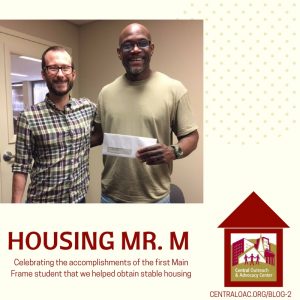
Housing Mr. M

by Ahren Cassinari-Foster

I first met Mr. M in the lobby of the OAC.  I was rushing off to do something else when he flagged me down and asked me about our job readiness program.  I assumed he was another guest wanting an answer to a question that he should be asking at the front desk-but I was very wrong!  He seemed like a nice enough guy when I met him but I had no idea that he would prove himself to be one of the most successful and focused job readiness students I have ever worked with.

When Mr. M first came to us, he was staying in a shelter, working on his addiction recovery, and just beginning to piece his life back together after some trying times.  After a few weeks of job readiness training, Mr. M found a job. Soon thereafter, he found a second job!

Over the next few months, Mr. M occasionally came in to the OAC just to say hi or to receive services.  After one of those visits we found out that we had been given access to a significant amount of money earmarked for housing for Main Frame students through the United Way.  Mr. M and I met and began to talk about the possibility of assisting him with rent.   

Soon enough, Mr. M had found a room to rent, had a contract drawn up, and was able to move in and pay the first month of rent (with a little help from the OAC and the United Way).  Since then, Mr. Murphy has paid the second month of rent by himself and is working with us on budgeting and saving strategies to help set him up for success over the long run.

It has been a pleasure to work with someone so focused on achieving self-sufficiency.  Often when we work with guests, we don’t see the success they achieve after they leave us.  Especially when we help people with supportive services, we don’t know if they are able to get housing and employment with the identification we help them obtain.  It has been really rewarding to see Mr. M progress from someone struggling with addiction and living on the street to someone who has two stable jobs and is able to pay his own rent.  We are incredibly proud of what Mr. M has accomplished and his story gives us hope.

Filed Under: Blog Posts Tagged With: employment, graduate, homelessness, housing, job, job readiness, Main Frame, success

November 16, 2017 By Central OAC

6 Reasons People Experiencing Homelessness Can’t Find Jobs

by Ahren Cassinari-Foster

There are many reasons both individual and systemic why our guests struggle to find jobs, but here are six of the biggest reasons why many of our guests have a difficult time finding satisfying, long-term employment.  This is not an exhaustive list, but I hope it opens a window into the reality our guests live with on a day-to-day basis.

1. Incarceration history.  Whatever the offense, having a recent criminal charge is a huge disadvantage when searching for employment.  Our guests are often faced with a very difficult choice: hide the offense and hope it does not come up in the background check (knowing you will be fired if the offense is discovered) or disclose the offense and hope for an understanding interviewer/HR department.

2. Gaps in employment.  For a wide variety of reasons, many of our guests have significant gaps in their work history.  These gaps are quite challenging to explain in an interview, complicate the process of resume –writing, and sometimes raise real concerns on the part of hiring managers.

3. Storage.  In my experience, not many people have thought about how a lack of proper storage can cost someone a job.  If a guest is carrying all of her worldly goods around in a pack, what is she supposed to do when it comes time to interview?   Does she leave the pack in a park?  With a friend?  Carry the pack to the interview and hope for the best?

4. Lack of educational opportunities.  Many of our guests have a fairly limited educational background and have not had ready access to the education and training that opens doors to higher-paying, stable jobs.   The lack of stability in both living situation and income that many of our guests live with makes the idea of completing a two semester course in arc welding at a local tech school a seemingly impossible dream.

5. Access to hygiene items and interview clothing.  Living outside, or in a shelter that is not a large upgrade over the street, affords people few opportunities to groom themselves on a regular basis.  Most people do not feel confident approaching a job search when they are unable to bathe on a regular basis and have no access to interview clothing.

6. Limited access to computers.  Many people in today’s world can take for granted 24/7 access to the technology they need to communicate, work, connect with friends, and do so many other things .  The vast majority of our guests do not have anything close to that level of access to computers, smart phones, or tablets.  They can access the internet on a restricted basis only when the local library has a free computer or one of the few computers in their shelter or transitional housing facility is available for use.

Despite these challenges, many of our guests do find jobs!  I am continuously challenged and inspired by folks who, despite a long list of setbacks and roadblocks, find a way to make their job search work through their determination and focus.

To learn more about our Main Frame Job Readiness program and the ways it helps remove these barriers, click here.

Filed Under: Blog Posts Tagged With: education, employment, homelessness, hygiene, incarceration, jobs, Main Frame

October 18, 2017 By Central OAC

Finding Thin Places

by Brenna Lakeson

When I was in seminary, we would often talk about “thin places” –  a phrase used by Irish priest John O’Donohue among others – to identify moments when the barrier between our earthly reality and the holy realm beyond seems to disintegrate.  A thin place might be as simple as seeing the sun rise or as poignant as watching a child be born.  A thin place is a moment where the boundary between yourself and God feels nonexistent, when the holy reaches out and touches you in a real way.  

At the OAC, it can sometimes be difficult to find thin places.  It can be loud and chaotic.  Sometimes our guests are angry and yell, albeit for warranted reasons.  Sometimes our guests are so tired of the brokenness they feel.  On the other hand, though, thin places are all around us at the OAC: a guest letting a stranger borrow his phone to call home, a whole line of able bodied individuals letting a lady in a wheelchair cut in line.  I want to share some of the thin places that I’ve been honored to bear witness to at the OAC, in the hopes that all of us will look for the thin places instead of the broken ones.


//


Paul

Recently, I woke up in the morning with a pulled neck muscle.  It was hard for me to turn my head side to side. I did stretches at my desk during the day to try to get some mobility back.  I apologized to each guest I met with, so they wouldn’t think that I was purposefully not looking in their direction.  One guest in particular, “Paul”, took an interest in my neck injury.  “That happened to me a while back,” he said.  “You gotta do your stretches.  And get some Bengay to put on there.  That’ll do the trick.”  Again on his way out, he reminded me to get some Bengay to relieve my pain.  

About a week later, Paul joined our Main Frame program, and I saw him at the OAC one afternoon.  “How’s your neck doing?” he called after me.  I smiled.  “It’s doing so much better, thank you for remembering!” I responded.  With all that Paul had to worry about, he managed to remember my insignificant pulled muscle and wanted to know if I was doing okay.  Whenever guests take the time to care for our staff and volunteers, I am always touched.


Mr. Peters

Last week, I worked with “Mr. Peters.” Mr. Peters was the first guest I served that morning.  I was tired and wasn’t feeling very energetic.  I just wanted to do my job and get through the list of guests without too much fuss.  Mr. Peters, however, wasn’t having it.  First thing, he asked me how I was doing on a scale of 1 to 10.  He told me he was an 8.5.  I told him I was about a 7, and he said he was determined to get me to at least an 8 by the time he left.  When I asked him why he wanted to get a Georgia ID, he told me he needed it to give blood.  Each time I smiled during our interaction, he would say “Are you at an 8 now?”.  On his way out, I asked him if he needed any toiletries or snacks.  He told me he didn’t want to take any because he wanted to save them for the “people who really need them.”  He was, however, very excited to share some salt water taffy with me.  

Despite his circumstances, Mr. Peters consistently found joy around him, even in some salt water taffy.  What’s more, all he wanted was to use his abilities to make other people smile.  After our meeting, he met with our representative from Social Security to apply for SSI benefits.  It was clear to me that Mr. Peters didn’t have much going for him.  Despite seeming like a nice grandfather, he didn’t seem to have any family that was supportive.  But he made everyone he met feel like family.  Despite not having any financial resources, he wanted to give what he did have – blood.  Meeting with Mr. Peters forced me to check my own feelings at the door.  I had come to work grumpy, but Mr. Peters had come to our center full of joy to share.


Jamal

Several months ago, I worked with “Jamal.”  Jamal had nothing but the clothes on his back, and we were helping him get a Georgia ID.  I gave him some of the donated clothes in one of our back rooms, and he was beyond grateful.  On his way out, he asked if we had a comb.  I told him that we didn’t.  He wanted to comb out the braids in his hair to re-style it, but we didn’t have anything to offer him.  He went on his way, and I didn’t think much of it.  

However, about an hour later, I walked through our lobby only to catch a glimpse of Jamal sitting on the ground with one of our female guests squatting behind him, combing out his hair for him and re-braiding it.  This moment has stuck with me in an indescribable way.  These two guests, arguably some of our loudest and, at times, challenging guests, were taking care of each other.  Like two children at a sleepover, they were chatting and braiding hair as though they had nothing else to worry about.  I watched them for a few minutes, sharing stories and relaxing in the courtyard.  It touched my heart to see our guests caring for each other in such an intimate way.


//


Our guests deal with more on a daily basis than many of us face in a lifetime.  However, every day we see them reach outside of themselves and care for those around them.  In circumstances where they have every reason to be selfish, they somehow find the strength to show compassion and kindness in often unexpected ways.  In the midst of suffering, they recognize suffering in others.  In the midst of trauma, they recognize the needs of others.  There is great holiness in this, and also a wholeness:  when we care for others, even when we are hurting, it helps us heal.

Filed Under: Blog Posts Tagged With: Central OAC, holy, homelessness, kindness, Main Frame, thin places

Primary Sidebar

Follow Us

  • Email
  • Facebook
  • Instagram
  • LinkedIn
  • Twitter
  • YouTube

Central Outreach and Advocacy Center, 201 Washington Street, SW Atlanta, GA 30303, (404) 659-7119