• Skip to main content
  • Skip to primary sidebar

  • Who We Are
    • Purpose and History
    • Annual Reports
    • Our Guests
    • Board of Directors
    • Staff
  • Programs
    • Supportive Services
    • Main Frame Program
    • Alison’s Boutique
    • Advocacy
    • Partners
  • Get Involved
    • In Their Shoes: Annual Fundraiser
    • News and Events
    • Giving
    • Volunteer
    • #GAgives on #GivingTuesday
    • Careers
  • Blog
  • Contact Us
    • Press
  • Donate

Central Outreach & Advocacy Center

housing

November 18, 2020 By Central OAC

The Link Between Poverty and Crime (It’s not what you think!)

by Brenna Lakeson

A lot of guests show up at our door because their identifying documents have been stolen. I’ve heard guests say countless times, “I don’t have anything. It was all taken.” This makes it so hard to start over. To get an ID, you need a birth certificate and a Social Security card. To get a birth certificate, you need an ID. It can feel like a relentless cycle for our guests who have nothing to go on. Thankfully, we’re able to help them break out of this catch-22.

Why do so many people on the street have their things stolen, though? More likely than not, their things are stolen by other people experiencing homelessness. Sometimes this notion is used as proof that people living in poverty, people of color, and people living outside are inherently more violent or more likely to commit crimes.  In reality, though, their experiences are what lead to crime. Our society is set up in a way that prevents them from getting everything they need so they feel forced to take what they need to survive. The reason our guests’ things get stolen is because desperate people turn to desperate measures to survive.

If you were cold, without a jacket or a blanket, and you saw an opportunity to take one from someone else, you might take that chance. If you hadn’t eaten in a day or two and your only option was to take someone else’s wallet while they were sleeping and unaware, you would do what you had to do. It’s tempting to say we would “do the right thing” in these situations, but what is the right thing? Is it better to survive by taking or suffer while sitting back?

While our guests are often upset by the fact that their documents get stolen, I rarely ever hear them complain about having other items stolen. They might be disappointed that some of their cash or clothing was stolen, but, usually, they let these things slide. They know what it feels like to take desperate measures. They know that when they have to make the decision to commit a crime or meet their most basic needs, it’s hard to say no to taking something.

People experiencing homelessness aren’t inherently violent or immoral. It’s their compounded trauma and desperation that causes them to lie, cheat, or steal. The systems that cause poverty create circumstances in which people make risky and rash decisions because they feel trapped. Our goal at the OAC is to help reduce these circumstances so that our guests are no longer caught in a cycle of poverty and, instead, move toward self-sufficiency.
Filed Under: Uncategorized Tagged With: crime, homelessness, hope, housing, identification, poverty

August 20, 2020 By Central OAC

The Hardships of Trauma

by Chattrelle Gillyard

Often we see homelessness as a choice. There is stigma surrounding homelessness that causes many of us to believe that people experiencing it are lazy. They’ve chosen to be homeless or unemployed or that they’re the reason why they are currently experiencing homelessness. But most people in this situation did not choose it. What’s more, many people experiencing homelessness have endured some sort of trauma in their life. According to SAMSHA, homelessness in itself is considered a traumatic event.

Could you imagine losing your home and your job due to a natural disaster such as a hurricane? Can you imagine aging out of the foster care system with no stable living place to go? Can you imagine growing up poor and never really having a place to call home? Or what about having to run away from home due to abuse or neglect at a young age? Though many are fortunate enough to overcome these particular traumas, others aren’t that fortunate. Mental health conditions, substance use issues, and even paranoia and lack of trust can develop from unresolved trauma. These conditions are also all barriers to employment, affordable housing, and proper health care. Many people experiencing homelessness battle with unresolved trauma every day and are constantly reminded of their situation and looked down upon. It’s easy to see what’s on the outside, and it’s easy to judge and make assumptions. It’s even easier to label people who are different from us. It’s harder to look past someone’s appearance or current station in life to sympathize with where they’ve been or what they’ve been through.

Though many of us have experienced the same or similar traumas as our guests, we still choose to believe the stigma surrounding people experiencing homelessness. We still speed walk past them, frown at a particular smell they carry, ignore them when we see them, and even talk down to them. We put ourselves on a pedestal to make ourselves feel better, all while ignoring the reality that we could be one traumatic event from experiencing homelessness too. I challenge you to follow the tenets and values of Central OAC when it comes to interacting with someone who is experiencing homelessness. Meet them where they are with patience and humility. Treat them with respect, and dignity. Trauma is all around us and affects everyone differently. Don’t be in a rush to judge more than you are to understand.

Filed Under: Blog Posts Tagged With: homelessness, housing, mental health, substance abuse, trauma

March 22, 2018 By Central OAC

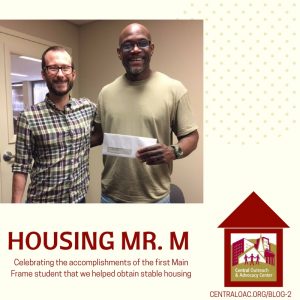
Housing Mr. M

by Ahren Cassinari-Foster

I first met Mr. M in the lobby of the OAC.  I was rushing off to do something else when he flagged me down and asked me about our job readiness program.  I assumed he was another guest wanting an answer to a question that he should be asking at the front desk-but I was very wrong!  He seemed like a nice enough guy when I met him but I had no idea that he would prove himself to be one of the most successful and focused job readiness students I have ever worked with.

When Mr. M first came to us, he was staying in a shelter, working on his addiction recovery, and just beginning to piece his life back together after some trying times.  After a few weeks of job readiness training, Mr. M found a job. Soon thereafter, he found a second job!

Over the next few months, Mr. M occasionally came in to the OAC just to say hi or to receive services.  After one of those visits we found out that we had been given access to a significant amount of money earmarked for housing for Main Frame students through the United Way.  Mr. M and I met and began to talk about the possibility of assisting him with rent.   

Soon enough, Mr. M had found a room to rent, had a contract drawn up, and was able to move in and pay the first month of rent (with a little help from the OAC and the United Way).  Since then, Mr. Murphy has paid the second month of rent by himself and is working with us on budgeting and saving strategies to help set him up for success over the long run.

It has been a pleasure to work with someone so focused on achieving self-sufficiency.  Often when we work with guests, we don’t see the success they achieve after they leave us.  Especially when we help people with supportive services, we don’t know if they are able to get housing and employment with the identification we help them obtain.  It has been really rewarding to see Mr. M progress from someone struggling with addiction and living on the street to someone who has two stable jobs and is able to pay his own rent.  We are incredibly proud of what Mr. M has accomplished and his story gives us hope.

Filed Under: Blog Posts Tagged With: employment, graduate, homelessness, housing, job, job readiness, Main Frame, success

Primary Sidebar

Follow Us

  • Email
  • Facebook
  • Instagram
  • LinkedIn
  • Twitter
  • YouTube

Central Outreach and Advocacy Center, 201 Washington Street, SW Atlanta, GA 30303, (404) 659-7119